
Millions of people have tried to copy Warren Buffett. Some buy the exact same stocks he owns, while others spend hours reading Berkshire Hathaway’s annual letters, hoping to decode his next move. Yet very few come close to matching his results.
Between 1965 and 2023, Berkshire Hathaway delivered a mind-blowing 19.8% compound annual growth rate (CAGR), nearly doubling the S&P 500’s 10.2% return over the same period.
Why is it so hard to replicate? Because his biggest secret isn’t a magic mathematical formula or a hidden stock-picking trick. It is his iron-clad emotional discipline. While Wall Street chases short-term excitement, Buffett plays a completely different game.
Let’s separate the myths from the hard financial facts.
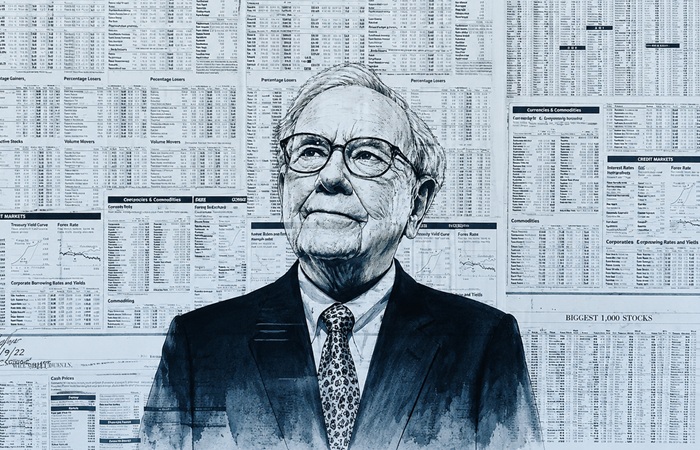
Myth #1: Buffett Only Invests in Dividend Stocks
The Verdict: False.
Buffett loves cash-generating businesses, but a dividend payout is a byproduct of a great business, not his primary rule for investing.
It’s true that Berkshire Hathaway rakes in massive dividend checks. The company pulls in billions of dollars a year in passive dividend income from core holdings like Coca-Cola, American Express, and Apple. But Buffett treats dividends as a bonus, not a requirement. His true goal is to find an outstanding business that can efficiently reinvest its own cash to grow for decades.
In fact, his own conglomerate, Berkshire Hathaway, has never paid a single dividend to its shareholders. Buffett argues that if a company’s management can reinvest profits at a high rate of return, it is mathematically foolish to pay a dividend, which forces shareholders to immediately pay income taxes on that cash.
Myth #2: He Ignores Stock Charts Completely
The Verdict: 100% True.
While short-term traders glue themselves to technical charts, moving averages, and daily price swings, Buffett completely ignores the noise. He has repeatedly criticized technical analysis, famously joking that he realized chart-reading didn’t work when he turned a chart upside down and got the same answer.
Instead of looking at the price of a stock, Buffett reads corporate annual reports, balance sheets, and cash flow statements. He views buying a stock as buying a fractional piece of a real, physical business. If you wouldn’t feel comfortable buying the entire company, Buffett argues, you shouldn’t own a single share.
Myth #3: Buffett Always Keeps Cash Ready for “Dumb Things”
The Verdict: True.
Most fund managers feel immense pressure to stay 100% invested at all times. Buffett strongly disagrees. If the stock market is overpriced, he is perfectly content to sit on his hands and accumulate cash.
To put this into perspective, Berkshire Hathaway entered 2026 sitting on a historic, record-breaking cash hoard of $397.4 billion a cash pile larger than the entire GDP of South Africa. Wall Street often criticizes him for “doing nothing” with this money. But Buffett knows that holding cash gives him the ultimate weapon: optionality. When the market eventually panics and people do “dumb things” during a crash, he has the immediate liquid firepower to buy elite businesses at a massive discount.
The Part Most People Miss: Even the Oracle Makes Billion-Dollar Mistakes
One of the biggest misconceptions is that Buffett is flawless. The reality is that he has made colossal blunders, and he is remarkably open about admitting them.
1. The Dexter Shoe Disaster
In 1993, Buffett purchased Dexter Shoe for $433 million. He missed the fact that cheap foreign competition would completely destroy the U.S. shoe manufacturing industry, and the business eventually went to zero.
But the real disaster wasn’t the $433 million loss. The mistake was that Buffett paid for the acquisition using 25,203 Class A shares of Berkshire Hathaway stock instead of cash. Because Berkshire stock went on to skyrocket, those exact same shares are worth roughly $12 billion to $18 billion today. Buffett openly calls this the single worst deal of his career.
2. Admitting He Was an “Idiot” on Amazon
Buffett famously stayed away from technology stocks for decades because they fell outside his “circle of competence.” Because of this, he completely missed the early explosive rise of Amazon. Years later, Berkshire finally built a position in Amazon, but only after it had already become a trillion-dollar giant. Buffett later publicly admitted he was “an idiot” for failing to recognize Jeff Bezos’s incredible execution early on.
3. Panic-Selling Airlines in 2020
Right at the onset of the COVID-19 pandemic in 2020, Berkshire liquidated its massive stakes in major U.S. airlines (Delta, American, United, and Southwest) at a steep loss. While he was trying to protect Berkshire from an unprecedented global shutdown, the airline industry recovered much faster than he anticipated due to massive government bailouts, causing Berkshire to miss out on billions in the subsequent rebound.
The Three Rules to Perform Better in the Market
If you want to improve your portfolio’s performance using Buffett’s actual blueprint, focus on these three pillars:
- Find the “Economic Moat”: Never buy a company just because its stock price is moving up. Buy it because it has a permanent competitive advantage that rivals cannot easily copy such as Coca-Cola’s unbeatable global brand recognition, or Apple’s fiercely loyal customer ecosystem.
- Focus on Return on Equity (ROE): Look at how efficiently a company uses investor money. Buffett looks for companies that can generate high returns on their equity without relying on dangerous amounts of debt.
- Master Your Emotions: The market fluctuates wildly based on greed and fear. Buffett’s core philosophy is encapsulated in his most famous quote:
“Be fearful when others are greedy, and greedy when others are fearful.”
Summary for Common Investors
You don’t need a 160 IQ to beat the average investor. You just need to change your timeline. While the rest of the world trades in weeks, hours, and minutes, Buffett buys with a preferred holding period of “forever.” True wealth in the stock market isn’t about finding the perfect hidden stock; it’s about having the extreme patience to let compound interest do the heavy lifting for you.

Afshi Speaks is a general interest blog dedicated to exploring the stories, ideas, and topics that shape our world. Our team researches and writes across a wide range of subjects to bring curious readers honest, informative, and engaging content.


Leave a Reply