Imagine doing everything right cutting back on salt, walking daily, and taking your pills only to find out the medical rules just changed.
For years, we were told that keeping our blood pressure around 130/80 mmHg was perfectly fine. But major new health updates have completely changed that assumption. High blood pressure (hypertension) still affects over 1.4 billion people worldwide, according to the official World Health Organization (WHO) Hypertension Registry. Shockingly, nearly half of them do not even know they have it because it rarely shows symptoms.
If you or a loved one are looking after your heart, the old rules are officially outdated. Here are 5 simple, groundbreaking medical discoveries you need to know right now.
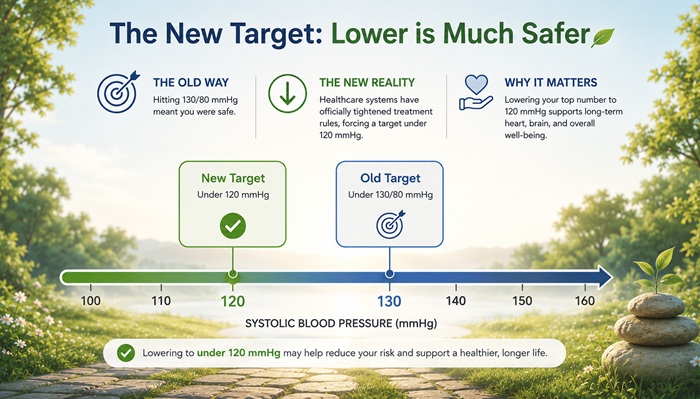
1. The New Target: Lower is Much Safer
- The Old Way: Hitting 130/80 mmHg meant you were safe.
- The New Reality: Healthcare systems have officially tightened treatment rules, forcing a target under 120 mmHg.
- Why it matters: The updated European Society of Cardiology (ESC) Clinical Practice Guidelines introduced an “Elevated BP” warning category for anything over 120 mmHg. Studies show that aggressively pushing your top number down to 120 mmHg slashes your risk of heart attacks and strokes, while protecting your brain against dementia as you age.
2. The 3-in-1 “Super Pill”
- The Old Way: Managing high blood pressure meant swallowing a messy cocktail of three or four different pills throughout the day.
- The New Reality: Doctors are now switching patients to a single, combined medication pill.
- Why it matters: Research highlighted by the British Heart Foundation (BHF) shows that single-pill combinations vastly improve how consistently patients take their medicine. Taking just one “Super Pill” in the morning controls your blood pressure smoothly for a full 24 hours, stopping dangerous early-morning blood pressure spikes while causing far fewer side effects.
3. Salt Substitutes Can Save Your Life
- The Old Way: Cutting out table salt is a boring chore just to drop your numbers by a couple of points.
- The New Reality: Swapping your regular table salt for a potassium-enriched salt substitute is a literal lifesaver.
- Why it matters: Landmark studies published in the National Institutes of Health (NIH) Blood Pressure Research Database show that using potassium-enriched salt reduces the risk of stroke and early deaths. Potassium acts like an internal pump, forcing your body to naturally flush toxic sodium out of your blood.
4. Blocking the Hidden “Blood Pressure Hormone”
- The Old Way: If three different medications failed to lower your numbers, your body was just labeled “resistant.”
- The New Reality: Scientists have discovered a new drug class that targets a hidden hormone.
- Why it matters: The FDA officially granted approval to Baxfendy (baxdrostat), the first-ever drug designed to halt aldosterone a hormone from your adrenal glands that secretly drives up blood pressure. According to data posted by the American College of Cardiology (ACC), this new therapy successfully drops numbers even when all other standard pills fail.
5. Weight-Loss Drugs (GLP-1s) Protect the Heart
- The Old Way: Weight loss injections are strictly for losing weight or managing diabetes.
- The New Reality: Heart doctors have officially integrated these medications into high blood pressure care.
- Why it matters: New clinical evidence published in Nature Medicine Research confirms that GLP-1 medications do not just lower blood pressure because you lose weight. They actively calm inflammation inside your blood vessels and help your kidneys release trapped fluid, acting as a highly advanced shield for your heart.
The Bottom Line
Managing your blood pressure is no longer just about avoiding a high number on a machine. It is about actively protecting your brain, your kidneys, and your future. If you are still aiming for the old standards, it is time to have a fresh chat with your doctor.
Disclaimer: This article is for general informational purposes only and does not constitute medical advice. Always consult your doctor or a qualified healthcare professional before changing your medication, diet, or treatment plan.

Afshi Speaks is a general interest blog dedicated to exploring the stories, ideas, and topics that shape our world. Our team researches and writes across a wide range of subjects to bring curious readers honest, informative, and engaging content.


Leave a Reply