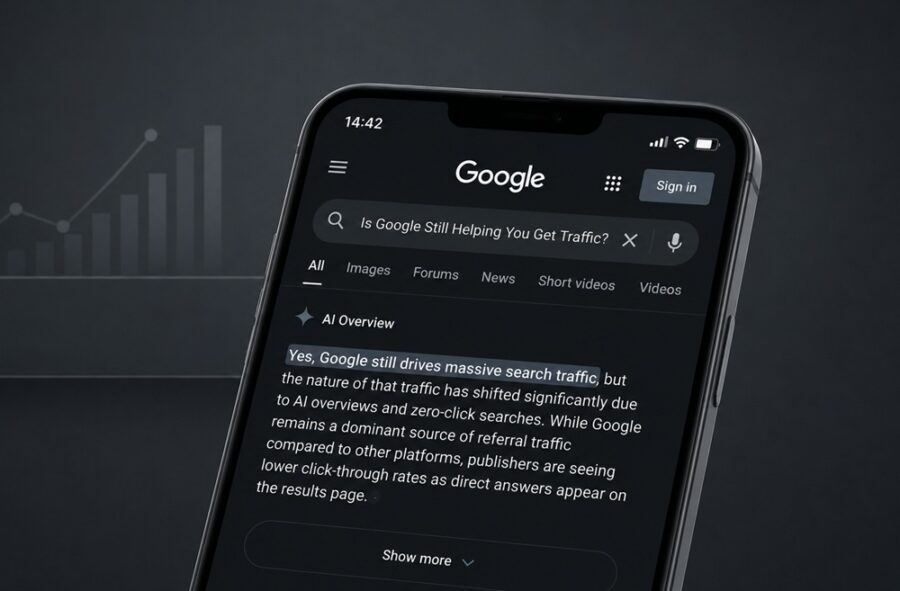
If you run a blog, digital magazine, or online business, you’ve probably noticed a troubling trend in your analytics over the last year: search impressions might look steady, but actual clicks to your website are slipping.
For over two decades, the open web operated on a simple deal: publishers create high-quality content, search engines index it, and users click through to read it. Today, that fundamental agreement is being quietly rewritten by artificial intelligence.
From 15% to 43%: The Shift in Search Data
Key Stat: Google AI Overview Growth
Data from Similarweb’s Generative AI Report shows Google AI Overviews surged from 15% to 43% of search queries in 12 months, while Google AI Mode visits doubled to 279 million.
Google AI Overviews appeared in 43% of U.S. searches, up from just 15% a year prior. Google is no longer just a directory routing users to third-party sites it is becoming the final destination.
What the Data Shows for Publishers:
- Zero-Click Searches Are Rising: Industry studies show nearly 68% of Google searches now end without a single click to an external website, as AI synthesizes answers directly on the search page.
- Longer, Conversational Queries: Similarweb reported a 5.4% increase in search length. Users are swapping brief keywords for conversational questions, giving AI more context to answer queries without sending traffic elsewhere.
- Referral Traffic Decline: Across independent blogs and major media outlets, referral traffic from Google search has dropped by an average of 30% to 33% over the past year.
How AI Changes Search Behavior
| Risk Level | Content Category | Traffic Impact |
|---|---|---|
| High Risk | Basic definitions, quick facts, broad “how-to” guides | Severe Drop: AI answers queries directly on the search page. |
| Medium Risk | Product roundups, buying guides, tutorials | Moderate Drop: AI summarizes key facts, but users still click for full specs. |
| Low Risk | First-hand testing, original data, brand searches | Protected: AI cannot fake real-world testing or proprietary research. |
Consider how a typical search interaction has changed:
- Old Way: A user typed
"how to clean cast iron skillet", saw 10 blue links, clicked your blog, and viewed your ads or affiliate links. - New Way: A user types
"how to remove rust from cast iron using vinegar without ruining seasoning". Google’s AI Overview generates a 4-step bulleted guide right at the top. The user gets their answer in 5 seconds and closes the tab leaving you with 0 pageviews.
The Ripple Effect on Publisher Business Models
When search referral traffic drops by 30% to 50%, the impact goes far beyond simple pageview counts. It disrupts the entire monetization funnel for digital publishers:
- Ad Revenue Collapse: Header bidding and display ad networks (like Mediavine, Raptive, or AdSense) pay per 1,000 impressions (RPM). Fewer pageviews directly mean lower monthly ad payouts.
- Declining Affiliate Sales: If users get product summaries directly on the search page, fewer buyers click through to your dedicated review pages to use your referral links.
- Slowed Email List Growth: Search traffic is usually the top of your marketing funnel. Fewer new visitors means fewer newsletter signups, shrinking your long-term owned audience.
Which Content Types Are Most at Risk?
Not all content gets hit equally. The less original your content is, the easier it is for AI to replace it.
- High Risk (Severe Traffic Drop): Basic definitions, simple “how-to” guides, quick facts, broad listicles, and generic summaries. If an answer can be found in a textbook, AI will synthesize it instantly on Google.
- Medium Risk (Moderate Traffic Drop): Product roundups, software comparisons, and buying guides. AI will summarize the key pros and cons, but motivated buyers will still click through for deeper specs or user reviews.
- Low Risk (Protected / Growing Traffic): First-hand testing, original data, personal opinions, real-world case studies, proprietary tools, and brand-name searches. AI cannot fake real-world human experience or invent original benchmark tests.
5 Quick Steps to Protect Your Site Traffic (GEO)
To survive in an AI-driven search ecosystem, creators must adopt Generative Engine Optimization (GEO) structuring content, so Google’s AI cites your website as its primary source inside the answer block.
- Add “Answer Cards” Under Subheadings: Place a concise 25- to 45-word direct summary right under your main headers before expanding into full detail.
- Use Conversational Headings: Replace generic headings like
Watering Tipswith real queries likeHow Often Should You Water a Monstera?. - Add First-Hand Evidence (E-E-A-T): Include original photos, personal testing data, or expert quotes. AI models prioritize citing real-world experience over generic rehashed text.
- Implement Schema Markup: Use
FAQPageandHowTostructured data so search crawlers can easily parse and verify your facts. - Build Owned Audiences: Focus on capturing email subscribers and direct traffic so you aren’t 100% dependent on search engine referrals.
Quick GEO Audit Checklist
- Does your post answer the core question in the first 2 sentences?
- Are subheadings formatted as conversational questions?
- Does the article include at least one original photo, dataset, or quote?
- Have you included FAQ Schema markup at the bottom?

Afshi Speaks is a general interest blog dedicated to exploring the stories, ideas, and topics that shape our world. Our team researches and writes across a wide range of subjects to bring curious readers honest, informative, and engaging content.

Leave a Reply