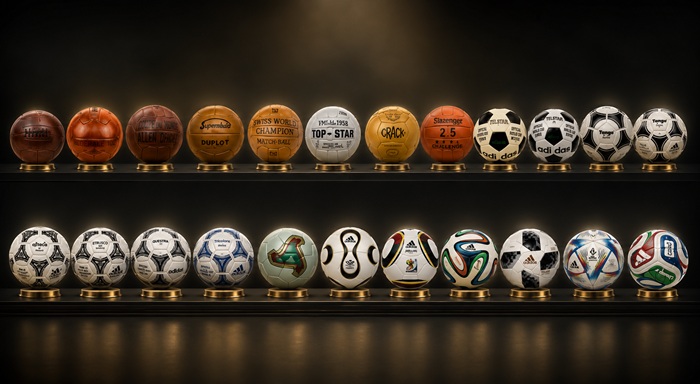
When we watch the FIFA World Cup, our eyes are glued to the superstars, the tactical masterclasses, and the breathtaking goals. But we rarely stop to think about the most critical piece of equipment on the pitch: the soccer ball itself.
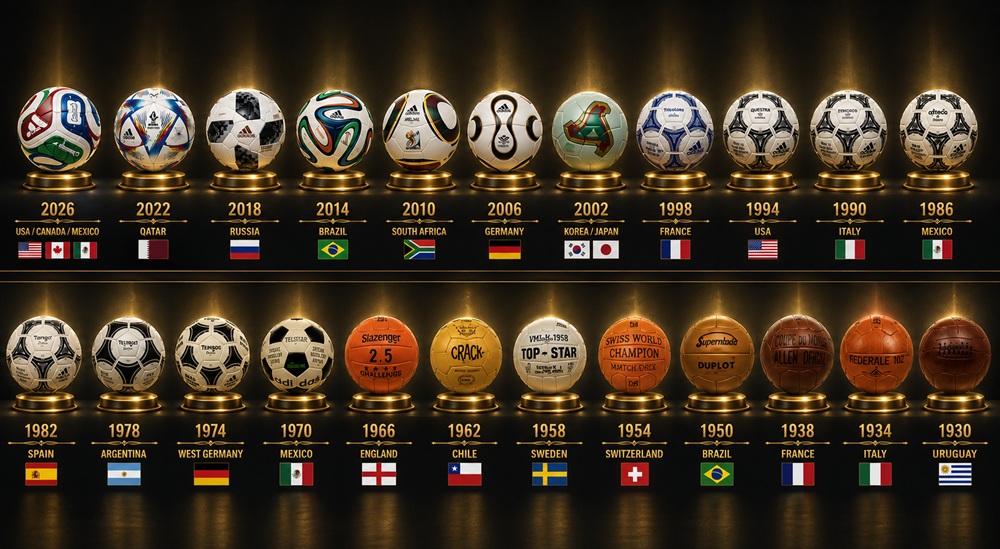
An internet-famous list claims that nearly every World Cup ball for the past four decades has come out of Pakistan. While that story is filled with national pride, the real history is a fascinating journey of globalization, technology shifts, and a single city that conquered the sporting world.
The Colonial Roots of Sialkot, Pakistan
To understand how a single city became synonymous with football manufacturing, you have to go back to British colonial rule. In the late 19th and early 20th centuries, British soldiers stationed in Sialkot, Pakistan, grew frustrated waiting weeks for soccer balls to ship from Europe.
Local artisans took apart damaged leather balls, studied the stitching, and began repairing and replicating them. By the mid-20th century, Sialkot had evolved into the undisputed hand-stitched football capital of the world. Today, the city produces nearly 70% of the world’s retail soccer balls.
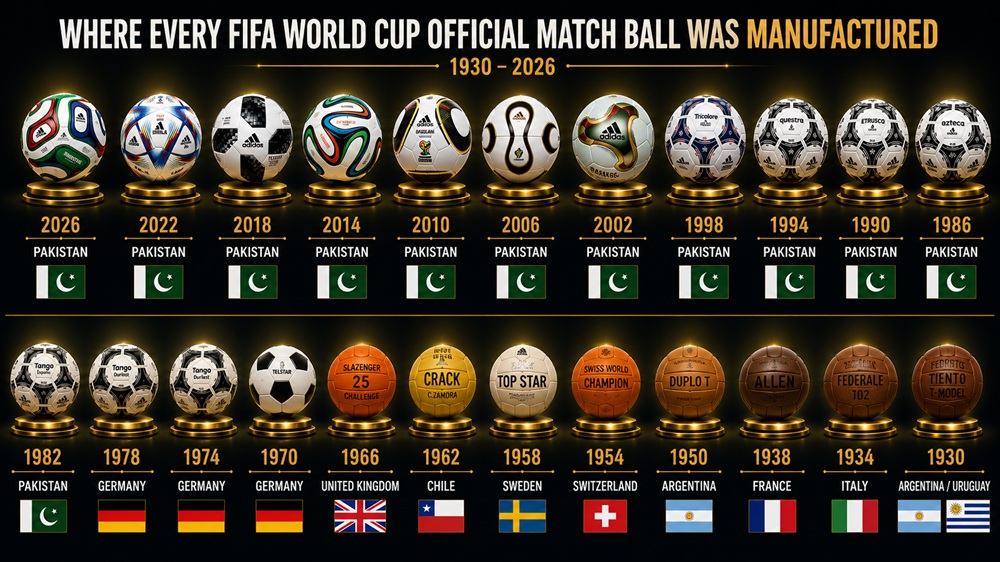
The Adidas Era and the Shift to Tech
Before 1970, World Cup balls were provided by local manufacturers in the host nations like Slazenger for England in 1966 or local craftsmen in Chile in 1962. That all changed in 1970 when Adidas became the official supplier, introducing the iconic black-and-white Telstar.
Initially, these high-end match balls were crafted in European factories across Germany and France. But as the game shifted from traditional leather to complex synthetic materials and thermal bonding (using heat and glue instead of stitches), manufacturing expanded into global powerhouse hubs like China, Thailand, and Pakistan.
The Verified World Cup Ball Manufacturing Timeline
| Year | Ball Name | Manufacturer | Made In | Key Note |
|---|---|---|---|---|
| 2026 | Trionda |
Adidas / Forward Sports | Sialkot, Pakistan | 4-panel design; side-mounted chip sending real-time data to VAR within 500Hz |
| 2022 | Al Rihla / Al Hilm |
Adidas / Forward Sports | Sialkot, Pakistan | Fastest WC ball ever; first WC ball built with sustainability as a priority |
| 2018 | Telstar 18 / Telstar Mechta |
Adidas / Forward Sports | Sialkot, Pakistan | NFC chip embedded inside; Mechta variant introduced for the knockout stage |
| 2014 | Brazuca / Brazuca Final Rio |
Adidas / Forward Sports | Sialkot, Pakistan | First WC ball named by public vote; one of the best-selling WC balls in history |
| 2010 | Jabulani / Jo’bulani |
Adidas | Sialkot, Pakistan | 8-panel design; widely criticised by players for unpredictable aerodynamics |
| 2006 | Teamgeist / Teamgeist Berlin |
Adidas | Sialkot, Pakistan | First WC ball with 14 panels instead of 32; thermally bonded, fully seamless |
| 2002 | Fevernova |
Adidas | Sialkot, Pakistan | Triangular design inspired by Japanese calligraphy and Korean tomoe symbols |
| 1998 | Tricolore |
Adidas | Sialkot, Pakistan | First multi-coloured WC ball; last ever to use the iconic Tango panel pattern |
| 1994 | Questra |
Adidas | Sialkot, Pakistan | Space-themed; honoured the 25th anniversary of the Apollo 11 moon landing |
| 1990 | Etrusco Unico |
Adidas | Sialkot, Pakistan | First WC ball launched alongside a full footwear & apparel collection |
| 1986 | Azteca |
Adidas | Sialkot, Pakistan | First fully synthetic WC ball; first named & designed to honour the host nation |
| 1982 | Tango España |
Adidas | Sialkot, Pakistan | First WC ball ever manufactured in Sialkot; last genuine leather WC ball |
| 1978 | Tango |
Adidas | Germany | Iconic interlocking triad pattern; also used in UEFA European Championships |
| 1974 | Telstar Durlast |
Adidas | Germany | First polyurethane-coated WC ball — waterproof and resistant to wear |
| 1970 | Telstar |
Adidas | Germany | First Adidas WC ball; iconic 32-panel black & white design built for TV visibility |
| 1966 | Challenge 4-Star |
Slazenger | England, UK | Selected in a blind FIFA test; bright orange version used for the final |
| 1962 | Crack |
Custodio Zamora | San Miguel, Chile | Locally manufactured; inconsistent quality across balls drew widespread complaints |
| 1958 | Top Star |
Sydläder AB | Ängelholm, Sweden | Chosen from 102 submissions in a blind evaluation by FIFA officials |
| 1954 | Swiss World Champion |
Kost Sport | Basel, Switzerland | First 18-panel ball with no laces; made by Kost Sport in Basel |
| 1950 | Duplo T / Superball |
Brazilian manufacturer | Brazil | First laceless WC ball; introduced the syringe valve for inflation |
| 1938 | Allen |
Allen | Paris, France | 13 leather panels hand-stitched with white cotton laces; supplied by host France |
| 1934 | Federale 102 |
ECAS | Rome, Italy | Supplied by Italy’s central sports authority; 12-panel brown leather construction |
| 1930 | Tiento / T-Model |
Argentina / Uruguay | Argentina / Uruguay | No single official ball — Argentina’s Tiento used 1st half, Uruguay’s T-Model 2nd |
The Modern Split: Match Day vs. Retail Supply
The internet loves to credit Pakistan with every single match ball since 1982, but the modern reality is a bit more nuanced. Take the 2022 World Cup in Qatar, for instance.
Sialkot-based manufacturer Forward Sports produced a staggering 5.5 million Al Rihla balls for the tournament’s global retail market and the official training fields. However, investigative reports verified that the actual match balls used under the stadium lights outfitted with complex real-time sensor technology were manufactured in China.
The story resets for the 2026 World Cup. The newly unveiled Adidas TRIONDA packed with a 500Hz motion sensor to aid in automated offside calls proudly carries the “Made in Pakistan” stamp for the official match-day lineup, cementing Sialkot’s tech-forward evolution.
A Global Footprint
From the hand-stitched leather of the 1930s to the AI-assisted microchips of 2026, the World Cup ball is a marvel of human engineering. Whether it is a factory in China, a specialized plant in Thailand, or the bustling industrial hubs of Sialkot, the ball remains a beautifully international creation. Next time you see a ball ripple the back of the net, remember the global journey it took to get there.

Afshi Speaks is a general interest blog dedicated to exploring the stories, ideas, and topics that shape our world. Our team researches and writes across a wide range of subjects to bring curious readers honest, informative, and engaging content.
Leave a Reply